.png)
Know Your Psychopolitics

“The title ‘Eyes Wide Shut’ captures the movie's central paradox: seeing without understanding. Kubrick suggests that power structures are not hidden, but ignored, existing in plain sight within accepted rituals and social norms. The greatest illusion is not secrecy itself, but the belief that we would recognise the truth if it stood directly in front of us.”
The other day, I got into a rather heated political discussion with a couple of old friends. We were discussing declining levels of freedom in China. I thought it appropriate to reference some democracy index data from V-Dem that I had studied for my undergraduate research project, which is constructed from an astonishingly varied set of measurable societal freedoms and attributes. Indeed, according to their data, China has declined on every major index since 2005.
And yet, one of my friends (a staunch Chinamaxxer) was quick to point out that despite not following explicitly “democratic” procedures, China has made dramatic improvements to infrastructure and standard of living, and therefore, he claims, how a polity scores on these indicators depends very much on one’s definition of freedom. What good are your civil rights if you are too hungry, too sick, and too tired to ever fully exercise them? A western-centric definition of liberal democracy, as valuable as it is, is not an objective standard for assessing the quality of governance.
The false equivalence we bounced between in our discussion became pretty clear: Freedom does not always require democracy, and “democracy” does not necessarily yield freedom.
However, the unavoidable truth is that the democratic freedoms that we in the West seek require the electorate to be listened to. In fact, all efficient and responsive governments have this requirement. Freedom is not meaningful if it does not come with an enforcement mechanism. In 2026 , it seems no one is being listened to. And no one knows what to do.
Over three and a half million pages of documents have been released on what I cannot describe as anything less than the most damning political scandal in modern history. Anybody who is anybody has had political, financial, sexual, and even banal arrangements with a college dropout school teacher turned mysterious billionaire paedophile. Dan Brown couldn’t have written it. As some of you already well know, Donald Trump is mentioned more times in the current tranche of files than Harry Potter is mentioned in Harry Potter. But they will assert there is not enough to go on.
Todd Blanche, the deputy attorney general, has claimed with a straight face that he did not find enough evidence to support any further investigations. Pam Bondi, who absolutely bungled her House Judiciary Committee hearing (watch from 3:35 onward here – cinema, but of the worst kind), ostensibly lied under oath when she claimed, among many things, that there is no evidence that suggests Trump has committed a crime, and that we should be grateful because The Dow is over 50,000.
Eventually, the conversation with my friends naturally drifted onto freedom of expression and the press. “What good is it,” my friend asked, “that we can talk about Epstein if our voice is heard and summarily turned into toilet paper?”
The fact that I can sift through the gigabytes of public data on the Epstein files and – this is the kicker – express my outrage about it online and organise a congressional hearing, or that The Guardian and the like can legitimately publish headlines like “The Epstein files reveal that a vast global conspiracy actually exists — sort of”, all for absolutely nothing to happen, is not just an outrage. Crucially, it is indicative of an active, and, I argue, fundamental erosion of freedom.
The better part arrives when we ask why that is.
I am not a conspiracy theorist: any anthropologist worth his or her salt would agree that, throughout human history, the ruling class have had a vested interest in the public narrative and the scope of debate. It is an extremely powerful tool of control, and they have gone to great lengths to protect it.
But Michael Foucault argued the “supreme” form of the power mechanism is not repressive. Rather, it is productive. Foucault’s Discipline and Punish: The Birth of the Prison speaks of a mode of enforcement that relies not on external coercion but instead on the individual themself. No longer are book burnings or costly, violent quashings of uprisings required. Your online psyche is now data, and the age of predictive algorithms allows the ruling class to exploit it.
Enter Byung-Chul Han’s Psychopolitics, where he outlines how the cocktail of digital technology, big data, and neoliberal individualistic attitudes have facilitated a system where your thoughts and emotions can be managed and directed “on a pre-reflexive level.” The subject, unaware, internalises power relations and mistakenly interprets them as personal choice.
However, far easier than the launching of mass-scale mind-control psy-ops, and certainly not as fanciful, is the erasure of the value of the narrative all together. Few ideologies have better realised this into an effective method of control than Trumpism. A polarised society that exhausts itself fighting over “the truth” removes its own capacity to organise.
So why bother with all the secrecy? Release the files. Because the same way the best lies are partly true, the best coverups are those that let you see just enough — enough to push you to cathartically scream and organise and exercise the freedoms the system has already accounted for.
We, especially those in America, must be better organised. Our collective catharses will not serve us. They are acts of self sabotage. They are permitted and controlled for. For each time we scream and no one listens, we further subjugate ourselves to a system in which a lack of enforcement is normalised as an unavoidable reality instead of being seen as a deprivation of a necessary mechanism of true democratic freedom.
I read that Eyes Wide Shut commentary in the caption of an instagram post a couple days ago. It seemed timely. But I think the greater illusion is that we, in our current state, are equipped to deal with the truth at all, let alone recognise it. Until we are, we will never be truly listened to, and our freedom will remain diluted, manageable, and exploitable.
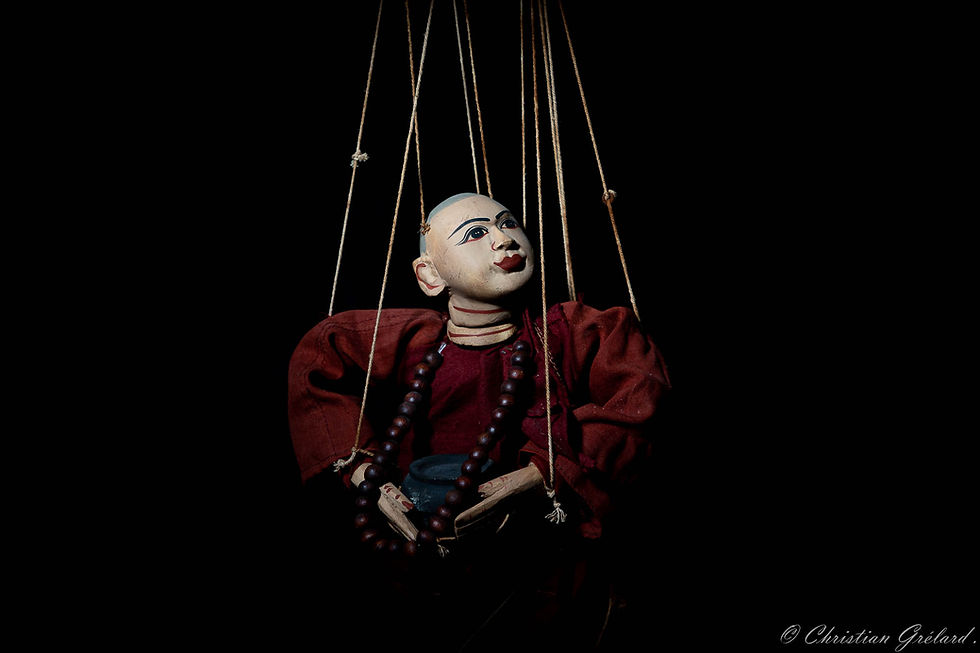
Image: Flickr/christian.grelard
No image changes made.


Comments