.png)
Gerrymandering and Political Good Behaviour: Why the Dems Can Still Lose

A Quick Refresher Before November
We are all expecting the GOP to hemorrhage congressional seats this November. Great. This is a de facto requirement of American politics, actually. That is, for the president’s party to lose seats in their first midterms – it’s happened in 20 of the last 22 cycles. And given Trump’s bonkers first year in office and the plummeting approval rating that has ensued, this is all but guaranteed.
But will a few more blue seats genuinely transform what has been a supine congress into one that’s ready to challenge a president that spent the last year largely sidestepping it entirely? Or, will it be more of the same, but blue?
Traders on Polymarket are now placing higher odds (about 45 - 50%) on a full democratic sweep of both the House and Senate than them simply just securing the House (about 35%) – the latter supposedly a borderline shoe-in.
That’s quite something. The House flip in 2018 is what gave Dems the majority needed to twice impeach Trump. Beyond yet another token impeachment, a blue majority House in 2027 would put a pin in Trump’s legislative agenda. Trump will then resort to Executive Orders (EOs), as he has before, and many will end tied up in court. The annual game of chicken with the debt ceiling now becomes an opportunity to gain further republican concessions, and their chairing of the congressional committees (and the subpoena powers that come with them) could make the GOP seriously sweat – particularly if they decide to properly weaponise the Epstein Files. Flipping the senate seals the deal. Not only could Trump not pass laws, he’d be unlikely to confirm any MAGA-leaning Supreme Court Justices, Federal judges, or new cabinet members. Trump becomes a landline and a pen until 2028.
But the mistake is forgetting that a landline and pen might just be enough – especially considering his track record of irreverence vis-à-vis rules tout court, and, more importantly, the Dems’ track record of serving as a toothless opposition.
Indeed, they still currently poll abysmally. But this is not an exclusively a post Biden-era problem. Since the 1990s, they have suffered from what a brilliant essay in the Columbia Law Review calls "asymmetric constitutional hardball.” Republicans, argue Joseph Fishkin and David Pozen, are just better and more consistent at pushing the norms of governance.
Conversely, the Democrats are seemingly bound to them. You know exactly what I’m talking about: this idea that if they play fair enough, and, in the face of republican transgressions, clutch their pearls tight enough, then, one day, these informed, progressive-but-not-so-as-to-be-’unreasonable’, ‘there-are-issues-on-both-sides’-spewing, NYT-reading voters will suddenly show up in droves for them, seeking refuge in the blue, ready to properly stand up to the rule-flouting, arrogant orange man. Gosh, this critique is painfully old now. But it's the same reason they’re now falling behind the gerrymandering race – the biggest window into how the GOP can still win, even when they're losing.
This race kicked off last year, when Trump’s team proposed redistricting within Texas to net the GOP more seats in congress. In a rare show of combativeness, the Democrats hit back, winning a ballot to submit a new redistricted congressional map in Virginia. It would have gotten them four new seats, had the Virginia Supreme Court not just overturned it – a massive setback for their midterm race.
This comes after the SCOTUS essentially gutted the Voting Rights Act in early May – the crucial piece of legislation that prevented states from dismantling districts where a minority group was a majority voting population. Now, it’s open season, republicans are rushing to it, and they “could net more than 10 seats from redrawn lines alone — “with several Southern states in the midst of redrawing their own districts.”
Democrats seem to be moving slower. They could continue to retaliate, sure. In fact, enough so to cancel out most if not all republican gains. The race is still on. And in the current climate, the expectation from many is that they have no choice. However, humour me for a moment and take a read of the following quote from that recent NYT piece about what “Peak Gerrymandering” could look like:
There are important reasons Democrats would not want to draw unanimously Democratic maps in states like California or Illinois. To do so, they would have to draw multiple pinwheel-like districts that stretch from Democratic cities out into the countryside. Southern California, for example, might need to look like this:
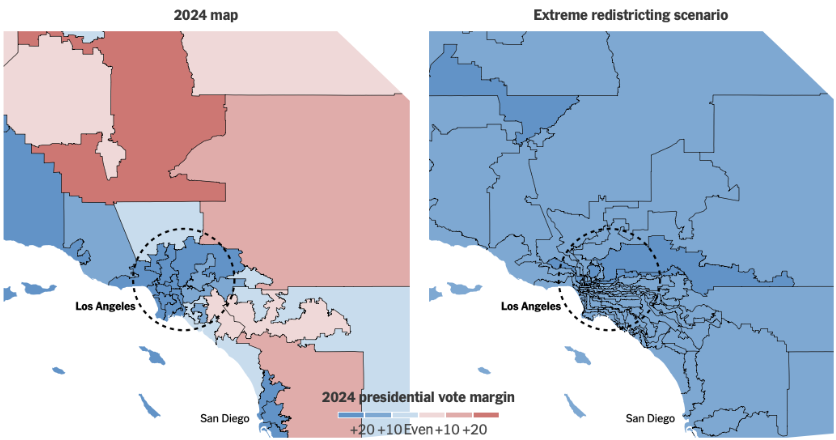
These districts would offend many moderate voters and deprive congressional incumbents of their traditional bases of support.
Good golly, how dare they imagine offending those moderates!
While I know the NYT does not officially speak for the architects of state legislature, nor am I disparaging Nate Cohn’s analysis, this is exactly the kind of decorum-over-progress thinking that led the Dems to tie their hands in their own states by implementing bi-partisan, independent redistricting commissions (which, in the case of Colorado, now needs a 55% voter-supported state constitutional amendment to be overturned) with the aim of meeting this outdated standard of political good behaviour. The GOP doesn’t give a hoot about your good behaviour. If they are given the chance to systematically rig the country in their favour, they will always take it.
Therefore, the idea that, upon the arrival of the Dems in the House, and perhaps even in the Senate, ‘normalcy’ and ‘restraint’ will finally resume is not only counting your chickens before they hatch, but indeed it is the opposite posturing Dems and progressive-adjacents need to be taking this November and beyond. With no departure from democratic tepidness, the political bazooka a dual chamber majority could be will remain under-utilised, and the GOP will remain stronger than they appear, no matter how rosy a picture the pollsters might give you.
Remain on the back foot, remain a step behind.
They have, repeatedly, proven themselves more committed to preserving the status quo of the political system than fulfilling their promises to voters. They have preferred the false peace of decorum to the true progress of democracy. If they choose that path again, they will lose their majority in 2022, and they will deserve it. — Ezra Klein
Image: Wikimedia Commons/Andra C Taylor Jr
No image changes made.


Comments