.png)
Will JD Vance Have A Kamala Harris Problem?

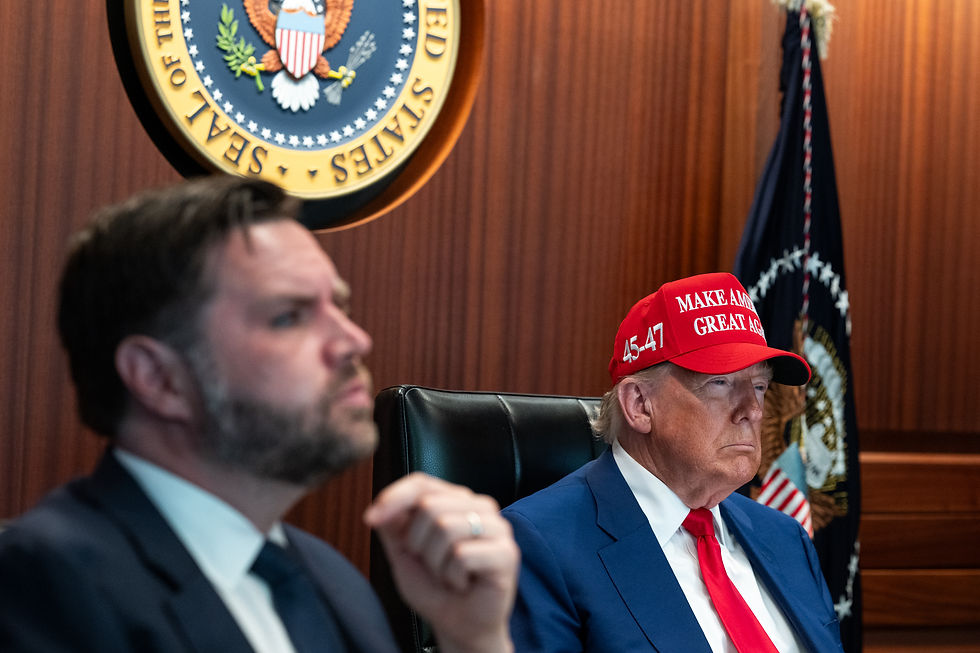
It feels like only a short while ago that everyone watched Kamala Harris attempt what many saw as an impossible balancing act: to defend an increasingly unpopular president while somehow preparing to inherit the party.
Now, JD Vance may be realising his vice presidency comes with the same trap; the parallels have become difficult to ignore as we approach 2028.
Both Harris and Vance have served under unpopular presidents. Both are expected to publicly defend every administrative decision. As they have played key roles as advisors and allies, both are constrained from openly distancing themselves from the president. However, both face a political reality: loyalty to the administration may damage their long-term electoral prospects.
The vice presidency has always required discipline. Under Donald Trump, however, extreme personal loyalty is not merely expected; it is demanded.
That creates a uniquely dangerous position for any ambitious successor.
After 1930, the vice president was traditionally positioned by the party as the natural heir apparent (although recently few have actually won). In theory, this strategy will only work if the administration remains politically popular.
When approval ratings fall as they have with Trump, the vice president inherits the blame by association without necessarily inheriting the authority to change anything. According to the latest YouGov poll, JD Vance’s disapproval rating now is at 52%.
Harris faced this challenge throughout the later years of the Joe Biden administration. She could not publicly separate herself from Biden-era inflation, immigration problems, or voter concerns about presidential age without appearing disloyal. Every defence of Biden weakened her own argument for generational change.
In 2028, Vance may face a similar dynamic. Trump’s governing style leaves little room for independent political branding. Those who become too prominent, too independent, or too ideologically inconvenient often find themselves marginalised or removed entirely.
The list of high-profile departures and political demotions from Trump-world continues to grow. Figures such as National Security Advisor Mike Waltz and Elon Musk have already seen what any political turbulence or disloyalty from inside the administration can result in. Others notably include Homeland Security Secretary Kristi Noem, who was fired for her controversial handling of matters relating to ICE and DHS spending, and Pam Bondi, who failed to shut down talk on the Epstein files fast enough.
The message is clear: In the Trump administration loyalty and reputation matter above all else, and independent power centres are dangerous. That leaves Vance with a difficult question: Is he truly being positioned as Trump’s successor, or merely being used as a shield for politically risky assignments?
One of the more striking examples is Vance’s involvement in negotiations surrounding Iran. This is politically delicate territory for him. Vance built much of his appeal on skepticism toward foreign intervention and an ‘’America First’’ platform. Being tied to diplomatic or military manoeuvring with Iran risks alienating parts of the populist base that supported his rise.
Another element of difficulty for Vance in this matter is that the objective of the war is unknown. Trump's messaging has been mixed at best. Senior officials in Washington have presented conflicting accounts of the war’s purpose, expected timeline, and overall aims. Nevertheless, Vance is tasked with negotiation to achieve this ambiguous outcome. This suits Trump perfectly. To quote the BBC, ‘’Trump joked in early April that he would blame the vice-president if talks fell through and take the credit if both sides struck a deal to end the war.’’
Vance has also found himself defending Trumpian rhetoric aimed at the Pope himself. He has warned the Pope to ‘’be careful’’ when talking about theology. This is a politically awkward position for a politician whose appeal relies heavily on Christian conservatives and Catholic circles. For many voters, especially religious conservatives, there is a large gap between defending a political administration and appearing combative toward religious authority. A line that Vance may have overstepped once or twice. Again, Vance’s room for manoeuvre is limited. Public disagreement with Trump carries enormous political risk inside today’s Republican Party.
Harris encountered the same structural limitation under Biden: defend everything, own everything, but control very little.
Complicating matters further is the rise of Marco Rubio.
For much of the last year, Vance appeared to be the obvious Republican successor. He had the populist credentials, the vice presidential platform, and strong support among Trump-aligned voters. However, Rubio increasingly looks like a plausible alternative choice. Rubio has said that “If JD Vance runs for president, he’s going to be our nominee’’. This statement has recently been called into question as Republican conversations increasingly revolve around whether Rubio represents a safer general-election candidate. Support for Marco Rubio has grown among Republicans, with some quietly discussing him as a possible 2028 nominee. ABC News reports that Trump has even asked donors whether they prefer Rubio or Vance, reflecting his tendency to set allies in competition with one another.
Ironically, Vance’s greatest political danger may not be Democrats, but proximity to Trump himself. If he remains fully tied to Trump, he risks becoming politically damaged by Trump’s increasingly erratic messaging and X posts. If he attempts to distinguish himself too aggressively, he risks being perceived as disloyal, and more problematically, he will face the political wrath of Trump.
There is yet another complication for Vance, one that makes his position even more unstable.
Parts of the MAGA movement do not appear psychologically prepared for a post-Trump Republican Party at all. Steve Bannon recently told The Economist that “Trump is gonna be president in ’28,” adding that “there is a plan” to keep Trump in power beyond a second term.
Whether a serious statement, base activation, or designed simply to antagonise the media, the statement reveals something important about the current Republican coalition: the succession question remains unresolved.
That creates a dangerous ambiguity for Vance. Normally, the vice president is the presumptive future leader of the party. But if influential figures around Trump continue entertaining scenarios where Trump himself somehow remains politically central in 2028, then Vance risks becoming politically stranded and unable to fully inherit the movement while still being required to defend it.
Kamala Harris faced a version of this problem under Biden, but with one critical difference: Democrats ultimately accepted that Biden’s presidency would end. Although they did so inarguably late, with only 107 days left for her to campaign.
That uncertainty weakens Vance from both directions. To Trump loyalists, he may never fully replace Trump. To establishment Republicans, he may appear too dependent on Trumpism to survive independently.
Harris spent years defending an administration she could not fully shape, only to discover that public frustration with the presidency eventually attached itself to her.
Vance risks the same fate.
The challenge for him is whether he can remain loyal enough to survive within Trump’s political movement while still building an identity separate enough to lead it afterwards.
That may be the defining Republican question of the post-Trump era.
Image: Wikimedia Commons/The White House (Daniel Torok)
Licence: public domain.
No image changes made.


Comments