.png)
Your Epstein Outrage isn’t Helping – Lucretia’s Rape and Patriarchal Veneers of Concern

Jeffrey Epstein’s child sex trafficking syndicate has become one of the defining examples of elite corruption in the past decade. With insurmountable living costs accompanied by a widening wealth gap, stories of elites using their enormous capital to sexually abuse underprivileged children have caused an uproar across American party lines. However, though many of these sexual offenders have been exposed to the public through the ‘Epstein Files,’ federal law enforcement under the Trump administration has refused to prosecute any perpetrators, likely including the president himself. Elites evading justice has only added fuel to the fire of a growing class resentment.
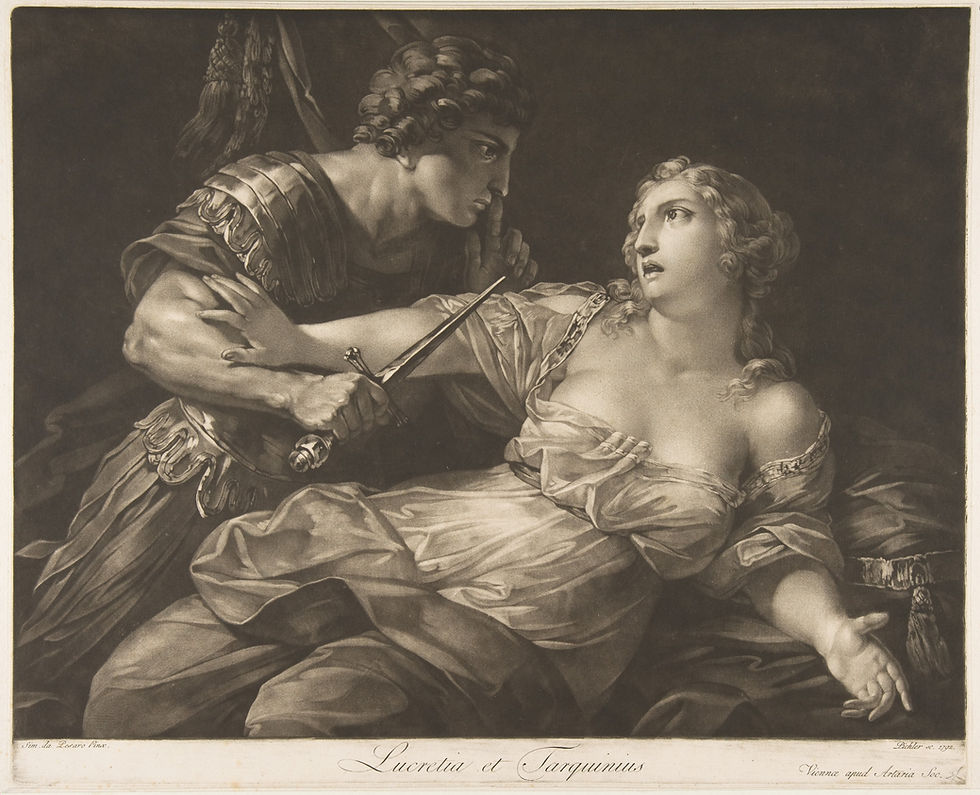
Historical parallels to the Epstein controversy can be found in Ancient Rome. Before the Republic, Rome was led by a series of kings. In Livy’s The Early History of Rome, he claims that the end of monarchical rule was the rape of Lucretia. Sextus Tarquinius, son of King Lucius Tarquinius Superbus, crept into Lucretia’s room and forced himself on her. Lucius Junius Brutus, upon discovering this injustice, led the overthrow of the corrupt monarchy. As depicted by thinkers such as Livy and Cicero, the Republic realized the evils of such unadulterated power, thereby creating a more balanced state.
The neat narrative of elite sexual violence being used as a unifying tool for a popular revolution can hopefully be an inspiration for the American people in our current moment. However, remaining at the level of such neatness can belie the gendered reality at the heart of Roman mythology. Livy uses the language of dedecus (to dishonor) and pudicitia (modesty) to frame sexual violence. Rather than the crime being centered around Lucretia’s traumatic experience, it revolves around her ‘honor,’ a patriarchal virtue distinct from her. In contemporary English, ‘rape’ contains this sedimented legacy through the Anglo-French ‘raper’ and Latin ‘rapere,’ which signify sexual violence as ‘stealing’ the woman’s virtue. The purity politics around this discourse rely on dissolving the woman’s subjectivity, instead positing her as the bearer of a foreign substance.
If the woman is defined by her chastity, the removal of her purity sentences her to nothingness. Lucretia, realizing this, commits suicide, leaving a letter for the men to avenge her. In another similar story on the tyrannical decemviri being overthrown due to sexual violence, Virginia’s rape concludes with her father killing her to preserve her virtue. Both deaths reveal their passivity in the stories. Ultimately, the mythologies become stories about a masculine people rising against a patriarchal elite, with the women unable to play an active role.
Though contemporary understandings of purity have changed, their historical remnants are evident. Firstly, the popular disdain among the people against Epstein, in contrast to other cases of sexual misconduct, comes from the discursive purity around children. For instance, Anita Hill’s status as an adult black woman prevented her accusations against Supreme Court Justice Clarence Thomas from gaining the same levels of support. Even though her case would make headlines, plenty of people overlooked her violence because black women do not meet the standards of purity. Relying on discourses of purity, which are grounded in white supremacy, privileges certain groups of people over others.
Secondly, a core aspect of purity is passivity. Another case of CSA that made headlines was Dr. Christina Blasey Ford’s testimony against Supreme Court Justice Brett Kavanaugh. While the ‘Release the Epstein Files’ movement did not have a coherent ideological backdrop, Ford’s accusations became one of the central parts of the #MeToo movement. Ford’s accusations became divisive because of their feminist nature challenging the audience’s underlying misogyny. Her case also centered her as a speaking subject, whereas survivors of Epstein, such as Virginia Giuffre, played largely auxiliary roles to the popular outcry. One could know Epstein’s crimes without knowing Giuffre, but one could not know about Kavanaugh’s crimes without knowing Ford. Her brazen subjectivity added a divided discomfort due to purity’s need to silence women.
Limiting Epstein to a metaphor of popular struggle allows people to remain unreflexive about their own violence. A dangerous myth about CSA is that most cases involve traffickers kidnapping children outside of the home. Instead, the vast majority of cases involve people who are familiar with the survivors in some way, often with the complicity of others. Though children’s purity may make their claims sound more horrifying, the familiar nature of the perpetrators and the complicity of their loved ones often makes survivors struggle with speaking out about their past. The divisiveness of Ford’s case also stemmed from the perpetrator being cast as the audience’s ‘son’ or ‘brother,’ whereas the elites are distanced from such a role.
Lucretia’s and Virginia’s deaths were necessary for Roman mythology. If they were to remain alive, the patriarchal basis of the gendered violence, past simply its elite appearance, would undo the sutured narrative. Similarly, the endemic crisis of sexual violence evident in the Epstein files, albeit not limited to it, will not magically disappear even if the elites are arrested. Congressmen such as Ro Khanna and Thomas Massie are quick to call for releasing the files, yet much slower to allocate funding to institutions that are attempting to reduce CSA and support its survivors. Intersectional feminist movements and movements against CSA should be at the center of this discourse, not at its margins.
Epstein can tether the people to struggle in unison against the elites. However, if the people are unable to reflect on their prejudices, they will be unable to organize for a properly democratic future. Machiavelli, in his commentary on Livy, argues that if the rape of Lucretia did not occur, the people would be outraged at some other tyranny, with sexual violence becoming metonymical. The people’s frustration was at the unjust republic, not at the patriarchal, structural preconditions underlying sexual violence. These preconditions are not auxiliary but at the core of liberation. If black women are discarded, CSA survivors are looked over, and feminists are ignored, these will ultimately harm the necessary movement building to construct a better future.
Image: Wikimedia Commons/ Johann Peter Pichler, after Simone Cantarini (The Elisha Whittelsey Collection, The Elisha Whittelsey Fund, 1951 – Metropolitan Museum of Art)
No image changes made.


Comments