.png)
Westminster After Widdecombe: Where Does British Politics Go From Here?

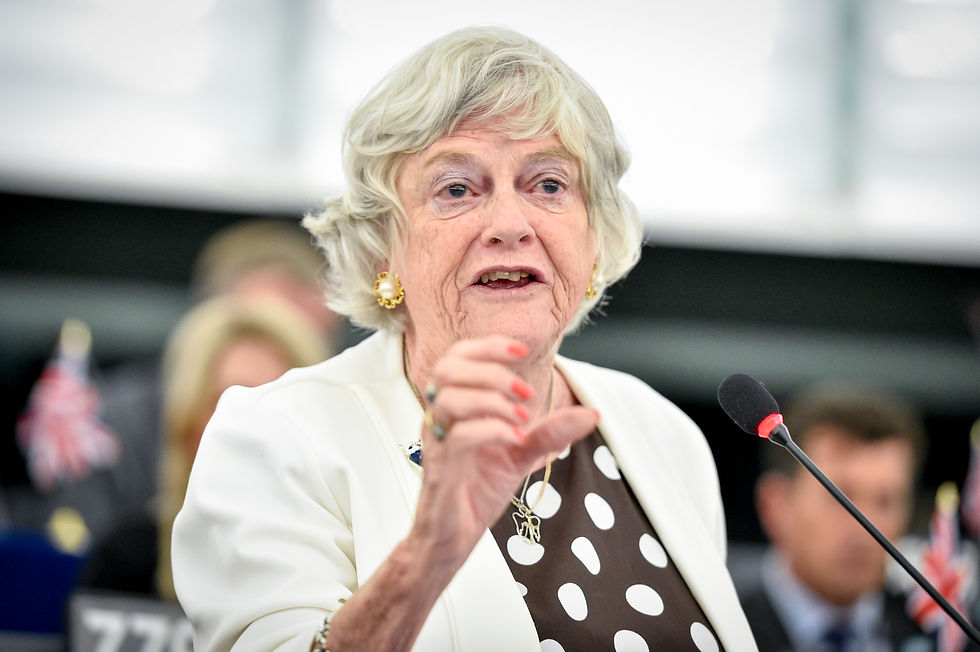
On Friday morning, news broke that one of Britain’s most recognisable political figures, Ann Widdecombe, had died. By mid-day social media was awash with tributes for a woman whose four decades in public life had taken her from Westminster to Brussels, and, most recently, to Reform UK as the party’s spokeswoman on Immigration and Justice. By mid-afternoon, national newspapers had published obituaries, some admiring and others searing in their criticism of a politician who possessed a near complete unfamiliarity with the political centre ground. By evening, news of Widdecombe’s passing moved from the somber to the sinister, after police confirmed they had opened a murder inquiry into the circumstances surrounding her death.
The significance of the former Conservative minister’s passing is difficult to overstate, Widdecombe was among the last generation of politicians whose careers bridged the old Conservative party of John Major, the Brexit years and the rise of Reform. Few politicians have remained as recognisable after leaving Parliament; her non-political ventures included an inelegant foray onto the ballroom floor of Strictly Come Dancing in 2010, while 2018 saw her set-up-shop in the household of Celebrity Big Brother.
There is a wider point to these reflections. Regardless of one’s own opinion of Widdecombe’s combative politics, she was, irrefutably and for nigh on two decades, a fixture of British public life. Her death also marks a deeply uncomfortable milestone. It is now the third time in a decade that the country has lost a politician to violence.
The murders of Jo Cox in 2016, and David Amess in 2021; the former by a British nazi and the latter by an Islamic extremist, were both politically motivated. On Saturday, Devon and Cornwall Police arrested a man on suspicion of Widdecombe’s murder, and, despite initially dispelling growing speculation that Widdecombe’s killing was an instance of political violence, handed the investigation over to counter terrorism police on Monday, following the emergence of ‘new information and evidence’.
In light of such a development, it now appears more likely that Widdecombe’s death will join that of Cox’s and Amess’s as evidence of Britain’s increasingly volatile political landscape. While three instances do not, in themselves, establish a trend, they nevertheless force Westminster to ask whether the assumptions that have underpinned British political life for generations remain fit for purpose.
Accessibility has long embodied the backbone of the British political tradition. MPs are duly expected to knock on doors, attend village fêtes, visit schools, hold regular surgeries and engage with voters without the suffocating layers of protection that are commonplace in most modern democracies. The Prime Minister does not traverse the country in a 50-piece motorcade, nor do backbenchers walk the streets of London flanked by burly men donning black suits and reflective sunglasses. In Britain, the relationship between representative and constituent possesses a deliberately informal facet.
I remember during the height of the pandemic, when the man tasked with shaping Britain's Covid-response, Matt Hancock, was stopped in the street, mid-jog, by an excitable crowd of journalists. The Secretary of State for Health and Social Care keenly obliged, and after a flurry of questions, was filmed running, alone, back into the fading light of London’s evening hue.
That particular interaction went well. Former Chancellor George Osborne experienced a less-extreme instance of this level of accessibility going awry when, during his wedding in 2023, the newly-weds were showered in orange confetti by a political activist. Widdecombe’s now former colleague, Nigel Farage, has also felt the brunt of exploiters of this political tradition; having been dowsed in an assortment of beverages during previous public appearances.
This informality represents one of Westminster’s greatest democratic strengths; Britain boasts a political culture in which elected representatives are expected to remain visible, approachable and accountable in a way that few of their counterparts elsewhere are. Every time this accessibility is exploited, whether that be in the most violent circumstances, or even in the comparatively harmless, that tradition is subjected to greater strain.
Cox and Amess’s murders saw security arrangements strengthened, police guidance expanded and MPs urged to rethink how they met constituents. Clearly, some of these measures were necessary, and Widdecombe’s death will inevitably reignite those very debates. Regardless, the dilemma remains an unenviable one; every additional security measure constructs yet another barrier between politicians and the public, at a time when the disconnect between the two parties appears starker than ever. A democracy in which MPs retreat behind barriers, police escorts and make public appearances only in predetermined settings is undoubtedly a safer one. It is also a remarkably more distant one.
An equally delicate question hangs over Widdecombe’s party, Reform, for whom the former was one of the latter’s most recognisable voices. Reform’s senior leadership has long warned that its portrayal by certain political opponents and sections of the media, not merely as wrong, but as inherently extremist, risks inflaming hostility and provoking violence towards its members and activists. Should police conclude that Widdecombe was indeed targeted for political reasons, those claims will certainly gain renewed prominence, and depending on circumstances, a degree of validity.
In any case, Widdecombe’s death comes at an already trying time for Reform’s leader Nigel Farage, whose acceptance of a £5 million donation, justified on the grounds that it would fund his ‘lifelong personal security’, had sparked sustained controversy in May. Farage, whom the state does not provide security to, now fights a by-election in his Clacton constituency. Although one would expect that his donor-scandal will be the topic of a wholly different, and far less scathing, conversation.
Westminster will inevitably, and, quite rightly, examine whether further protections for politicians are needed. But in doing so Parliament must recognise what is at risk; Britain’s political culture has long been predicated on the idea that those who govern should remain accessible to those they represent. While every new layer of protection may make politicians safer, it also renders representative democracy more distant. The police investigation will establish what happened to Ann Widdecombe, but the harder question for Britain’s political class is what happens next?
Image: Wikimedia Commons/European Union – 2019
Licence: European Union – 2019
No image changes made.


Comments