.png)
Does NATO’s Future Involve Defence Minilateralism?

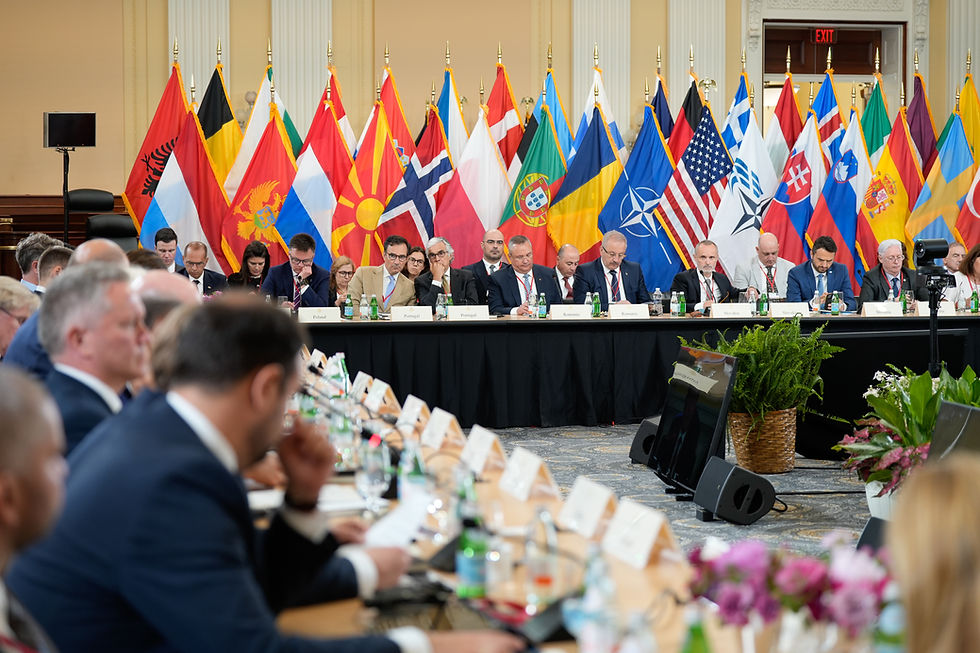
The NATO Ankara Summit, which took place over 7-8 July, returned the future of Europe again to the forefront of discussion. When considering the possibility of a reduced US presence in NATO, one trend that has arisen is a turn towards ‘minilateralism.’ Indeed, Galip Dalay of Chatham House wrote that “minilateral models point toward the architecture of a post-American European security order.” Minilateralism consists of small coalitions of states which possess shared threat perceptions and interests – such coalitions could play an increasingly important defence role in coming years.
Minilateralism is not new, but rather a return to a historic practice of coalition building and international relations before the age of multilateralism. What is distinct in recent years is the increased frequency of minilateral meetings. Numerous examples have arisen over the past few decades from the establishment of the Weimar Triangle in 1991, involving Poland, France and Germany, to integrate Poland into Europe following the collapse of the USSR; to the E3 in 2003, consisting of the UK, France and Germany, which focused on Iran’s nuclear programme, and the Joint Expeditionary Force, created in 2012, involving the UK and Northern European states with the intention to protect the High North, North Atlantic and Baltic Region.
Minilateralism has many advantageous qualities. Smaller groups facilitate efficient decision-making and effective diplomacy, which can lead to a faster crisis response. Minilateralism is also beneficial for enhancing interoperability, which aids capability development in the long term, and military integration, which would underpin NATO’s standardisation initiative. Minilateralism also creates opportunities for allied intelligence exchange, action on resilience commitments and general preparedness. Such arrangements would thus set NATO’s European members on the path to greater self-reliance.
Moreover, minilateralism appears to be genuinely effective, despite practical limitations. The Weimar Triangle has continually encountered challenges pertaining to relative imbalances in international influence between France, Germany and Poland, and remains fraught with political differences on topics like a European vs US led NATO and nuclear energy. Yet, it has been effective in fulfilling one of its primary objectives – the integration of Poland into the framework of the European Union and Europe at large. This has been instrumental in facilitating Poland’s rise as a major and influential member in Europe.
The E3 has endured internal political differences as well, such as French initiatives to block the UK from access to the Security Action for Europe fund. Yet, the minilateral played a key role in the implementation of the Joint Comprehensive Plan of Action in 2015, which saw the monitoring of Iran’s nuclear facilities. The E3’s success is further shown by its ability to adapt and address other issues beyond its founding purpose, like security challenges across the Middle East, such as in Syria and Iraq, and in the Sahel region of Africa. This has proven important for maintaining strong diplomatic relations between the UK, France and Germany in spite of Brexit, which is important for discussions on European security.
The Joint Expeditionary Force has also been highly effective. Though limitations exist, such as access to resources, which can impede the rapidity of response – this was highlighted following JEF’s delayed response – attributed to the UK’s lack of deployable ships and aircraft - when pipelines and cables were severed between Finland and Estonia in October 2023. However, JEF is highly beneficial in acting as a complementary source of cross-government interoperability to NATO. Moreover, JEF strengthens and nuances NATO’s collective defence by responding to threats which exist below the NATO Article 5 threshold with efficiency and regional expertise. Lastly, JEF has played a key role in championing support for Ukraine, and its members have committed $11.1 billion more aid than the remaining 18 NATO European members.
Minilateralism thus facilitates purpose-driven initiatives, bypassing complications which arise in larger bureaucratic multilateral organisations. Yet, simultaneously minilateralism can be undermined by political fragmentation and wavering commitment.
And so, if minilateralism is seen as a response to a reduced US capability in NATO, then addressing these limitations is essential. One way of ensuring this would be establishing a mechanism of accountability. Integration of new defence minilateral coalitions into the NATO Command Structure, alongside frequent report writing, coordination with NATO divisions, and regular meetings between NATO personnel, foreign and defence ministries, could underpin this strategy.
Image: Flickr/Saeima (Juris Vīgulis)
No image changes made.


Comments