.png)
Iran and the United States

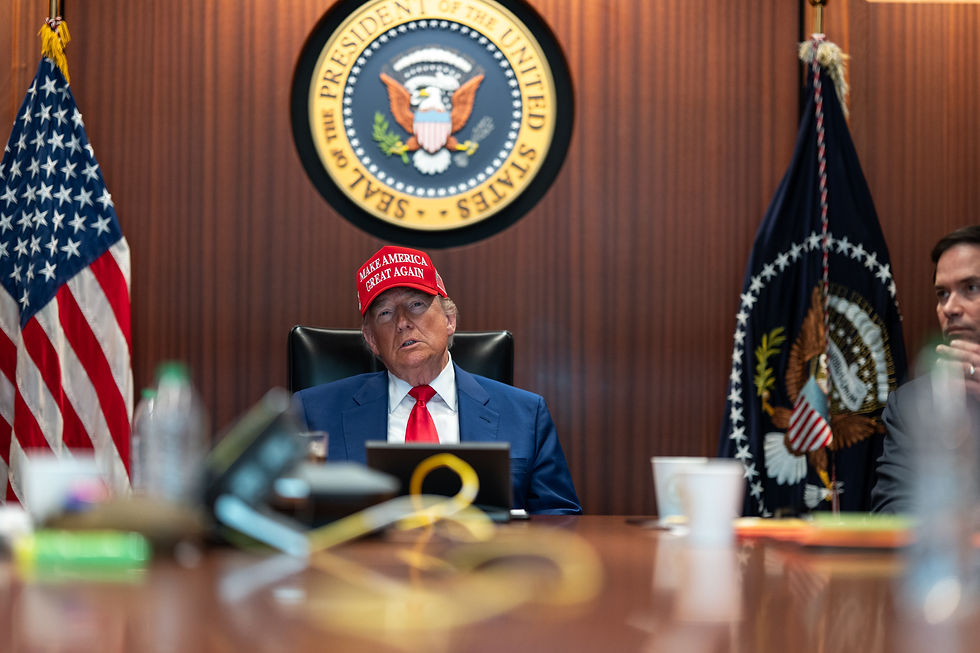
One of Donald Trump’s many pledges to the American electorate was to end United States involvement in what he coined ‘forever wars’. And yet, weeks past have seen further strikes on Iran by the US – a response to attacks on vessels in the Straits of Hormuz, despite a 60 day interim agreement between the two countries being signed in June. Does this conflict reflect the waning geo-political power of America, rather than the tyranny of the regime in Iran?
The relationship between the United States and Iran since the second World War has been a difficult one. As far back as the Shah, the regime has oscillated between an era of intense, strategic alignment and decades of deeply entrenched hostility. Across the last eight decades, from the Shah to the Ayatollah, American democracy has locked horns with Iranian authoritarianism, culminating in events such as the closure and mining of the Straits of Hormuz. It is in the recent Iran-US war that the regime has wedded its resilience to outside interference with venomous retaliation, 20% of the world’s oil is now under their jurisdiction – whether the Trump administration wants to acknowledge the grave implications of this or not.
Now that the regime has been decapitated, uranium enrichment facilities ostensibly decimated and its navy destroyed, the Iranian Revolutionary Guard knows it must lean on its trump card as much as possible to stand up to the American imperialism it so despises. This has only become more evident as ceasefires are announced only to be broken, as was the case on 12th July when a further wave of strikes by America was launched after Iran hit a transiting ship.
Interventionist;
The contemporary architecture of U.S.-Iran relations has been profoundly shaped by external intervention, a cycle that arguably began in earnest with the 1953 CIA-backed coup d'état that overthrew Iran’s democratically elected Prime Minister, Mohammad Mosaddegh, after he moved to nationalise the country's oil industry. By fortifying the authoritarian Shah Mohammad Reza Pahlavi, Washington secured its economic and Cold War interests but sowed deep-seated public resentment. This interventionist framework flipped on its head during the 1979 Islamic Revolution, which birthed a fiercely anti-American regime that subsequently held 52 Americans hostage for 444 days. This pattern of direct confrontational intervention remains ongoing; escalating friction over regional proxies and failed nuclear pacts ultimately culminating in the series of devastating U.S. and Israeli military strikes against Iranian infrastructure this year.
Volatility;
The relationship, historically, has therefore quite literally been a geopolitical pendulum, swinging violently between brief attempts at diplomatic engagement and severe military escalation. It nevertheless remains defined by the 1979 Islamic Revolution, which cemented Washington as the ‘Great Satan’ in the eyes of Tehran's new theocracy. While the 2015 nuclear agreement (JCPOA) offered a fleeting window of stabilisation, the subsequent U.S. withdrawal and introduction of heavy economic embargos plunged relations back into rapid destabilisation. This chronic instability peaked with direct warfare, resulting in a series of severe U.S. and Israeli military strikes against Iranian targets that triggered extensive counter-strikes across the region and effectively paralysed global trade routes.
It is only becoming more evident that the U.S is stumbling around in the dark, firing shots off in any direction to exemplify military might; without any key objective or logic underpinning the operation. It was realised all but too late that Iran could not be toppled in the same manner as Nicolás Maduro in Venezuela. The strong-arming of an adversary no longer seems to be something the U.S can effortlessly effect, at least while the current capriciousness is embedded in their foreign and domestic policy. The longer this war wages without resolution the further America’s standing as a bastion of the democratic free world sinks, with questions being asked of American power and whether it is indeed the steadfast entity it once was which is able to wield to protect democratic society. Iran may be geographically dwarfed compared to the continental United States, however the lack of understanding the Trump administration appears to have of the deep roots the IRGC has garnered since 1979 has been their undoing in this conflict. Ultimately, this stalemate signals a profound shift in the global order, exposing the limitations of Washington's traditional playbook of overwhelming kinetic force.
By failing to secure a decisive victory against a resilient adversary, the U.S. inadvertently demonstrates to other global rivals that American hegemony is no longer absolute. This perceived decline in deterrence capability suggests that the era of uncontested American unipolarity is rapidly giving way to a more fragmented landscape where military dominance no longer guarantees geopolitical obedience, indeed a world where regional actors can successfully construct their own spheres of influence, blunting even the most sophisticated Western war machines.
Image: Flickr/The White House (Daniel Torok)
No image changes made,


Trước đây mình toàn đánh theo linh cảm, quen vài con rồi cứ thế mà theo nên kết quả lúc được lúc mất, trúng thì cũng kiểu hên là chính. Gần đây mình cố gắng làm bài bản hơn: ghi lại cầu mỗi ngày, rồi tự lọc những con hay làm mình rối để khỏi bị cảm xúc kéo đi. Có đợt mình thử áp dụng Dàn đề 10 số khung 3 ngày như một cái khung để tham khảo thôi, sau đó dựa vào cầu mình đang bám mà gạch bớt những số thấy lệch. Không phải lần nào cũng về, nhưng đổi lại mình có quy trình rõ ràng, biết mình chọn vì lý do gì và khi…