.png)
Cynicism, clicks, and capitalism: why Network is more relevant than ever

Set in 1970s New York, Network follows the fictional Union Broadcasting System (UBS) and its attempts to monetise its increasingly unstable news anchor, Howard Beale. Above all, it is a story about incentives; an examination of what drives human engagement. In this sense, it has become timeless, predicting a cynical turn in American media and politics that has lasted half a century. As a result, anyone wishing to understand the United States’ current political culture would do well to give it a watch.
Initially fired by UBS, the aforementioned Beale wins back his position following two outbursts live on air that cause a spike in viewership. Actress Faye Dunaway plays Diana Christiensen, a hard-nosed TV producer who recognises Beale’s pecuniary potential. When UBS merges its news and entertainment divisions and makes Beale the network’s main attraction, Christiensen’s vision pays off.
Then, when Beale’s star starts to fall, Christensen pulls together a competing cadre of leftist terror organisations for what becomes the Mao Tse-tung Hour. In perhaps the film’s best scene, these Marxist revolutionaries hammer out contract negotiations amongst themselves and the network execs. “Don’t fuck with my distribution costs,” warns one group leader, “the Communist Party’s not gonna see a nickel out of this goddamn show until we go into syndication.”
If the platforming of borderline psychotic news presenters and terrorists was satirical fodder for a seventies audience, the trends Network exposed have carried on into the present day. The desire to capture audience attention didn’t slow down. Indeed, it sped up as cable TV flourished in the 1980s and the oligopoly of America’s TV networks broke apart. Haynes Johnson, a Pulitzer Prize-winning journalist and historian, argued that the introduction of cable, by the 1990s, created a “mass media scrambling for survival in the face of an increasingly fragmented market.” And how best to survive, according to Johnson? With the Diana Christensen playbook, of course: “by offering sensation and spectacle.”
This is a playbook that worked in the 1970s, in the 1990s, and still works today. Yet while the incentives that underpin this playbook have remained the same, updated editions have been necessary for today’s radically different media environment. Howard Beale’s ravings were marketed to the American people as the unfiltered insights of a prophet; in our current digital age, prophets abound without end. The deluge of podcasts and influencers one comes across even as an infrequent social media user attests to this fact.
Some, of course, are merely platforming conversation for the purpose of learning and discussion. Many, however, are concerned with directing their audience, just like Beale. In a world where “to go viral” is, ironically, often viewed as a positive, it is no wonder that so many Howard Beales populate public discourse.
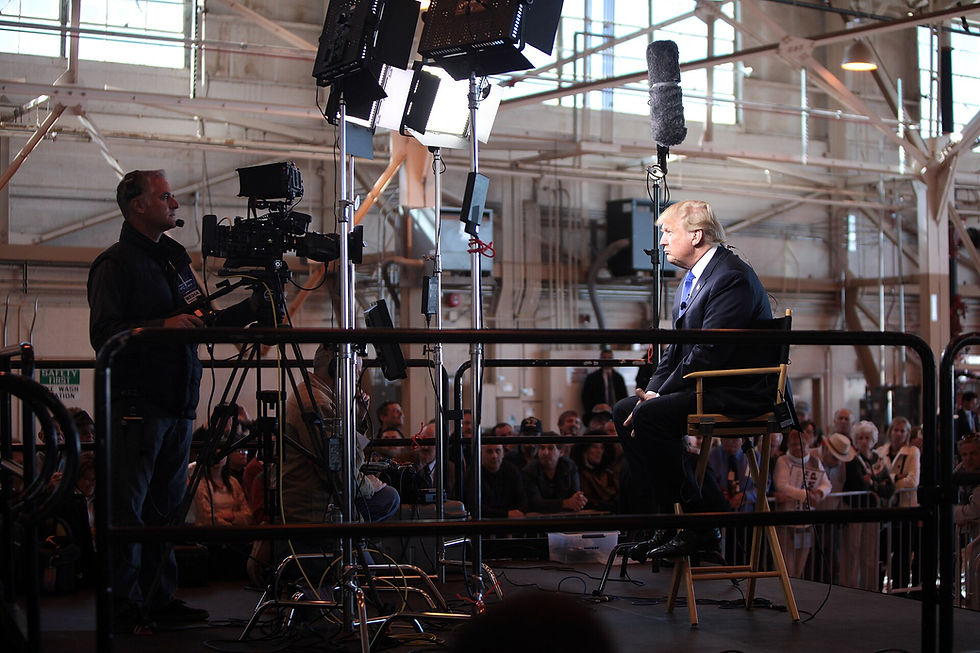
In 2016, Donald Trump’s candidacy for president demonstrated the political consequences of this last half-century’s incentive architecture. Focus on Trump, write political historians Julian Zelizer and Kevin Kruse, “resulted in a surge in profits” for cable news channels. The soon-to-be president was cut from the Howard Beale cloth: an entertaining figure whom media outlets, both left and right, could justify spotlighting each day of the (long) campaign season. And the effect cut both ways. According to the Brookings Institution, the free media attention Trump generated in his first run for office—what’s known as earned media—totalled $5.9 billion. This compared to only $2.8 billion for the less eye-drawing Clinton campaign.
Fast forward a decade, and the 2026 midterm elections show little promise of breaking this cycle. Given Trump currently occupies the Oval Office, media attention is to be expected. However, it is the president’s promises that smack of a more cynical approach to politics. His pledge of $5,000 to every American should Republicans win the midterms is an overt money-for-votes grab. These campaign promises suggest US politics is on a trajectory past merely influencing citizens with politics-as-entertainment. Even if swing voters remain unconvinced by such promises, they certainly have the potential to galvanise one’s base.
There is as yet no film advertised that promises the biting wit of Network. However, with the new incentives today’s politics is starting to inculcate, there ought to be. The original script, written by Paddy Chayefsky, was as acerbic as it was prescient. Rather than slowing down, the trends the film recognised sped up, and are now beginning to transmogrify. A less transactional approach to politics, and a new set of incentives in the media and society, will be necessary to arrest these trends. Otherwise, the next fifty years of US politics may grow bleaker still.
No image changes made.


Comments