.png)
Charlie Kirk: A Life and Death of Irony
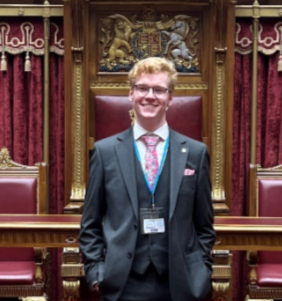

A year ago, the political activist Charlie Kirk was assassinated in Orem, Utah.
Despite efforts to oppose it from his allies and fan base, the man has become more a meme than a galvanising symbol of the right – a phantom of AI-Generated images whose presence elicits humour rather than grief or remembrance.
As the founder of the political activist organisation Turning Point USA, Charlie Kirk was an instrumental part of promoting the Alt-Right to everyday Americans, and an active contributor to the rise of Christian Nationalism in the US. Turning Point rejected the Separation of Church & State; promoted a national church to ‘eliminate wokism’ (which looks ripped from The Boys); engaged in culture wars surrounding Islam, transgender people, gay people, and weaponry; and promoted the idea that academia discriminated against conservatives and promoted anti-American values while promoting leftism – a claim that has still not been verified by the organisation.
But Kirk, even as the CEO, still made himself available to the public, routinely travelling around the States to ‘debate’ university students, and making himself available to high-ranking conservative events, such as CPAC and even an appearance at Oxford University, which it is admittedly unclear whether it was humiliating or legitimising for Kirk.
One of the primary methods he utilised to gain traction among young viewers was a mix of trolling and moot-and-bailey arguments, namely making outlandish claims only to retreat into calling them ‘a joke’ after resistance. Some draw this up to vengeance against the liberal colleges, while others suggest it was more so a humiliation ritual for young people who were not conservative (thus encouraging others to become conservative to avoid humiliation). His debates were marred by deflections, demands for irrelevant concessions, over-talking opponents, rejecting the onus of proof, and Gish gallop. Kirk became known as a very performative debater, uploading clips of him ‘owning the libs’ to TikTok and YouTube into compilations. This meant that, to those unaware of his politics or his reputation, he seemed a talented and well-informed man seeking to correct misinformed ‘woke’ college students, making him an essential part of the Alt-Right pipeline, and eventually aiding Trump in both of his elections.
As Trump succeeded politically, Kirk advanced too, being routinely invited to the White House, and his rare critique of Trump was met without vitriol from the President. He was evidently a well-respected voice within the American Alt-Right. And he used this position to push his own ideas, such as claiming that school shootings were “worth it…so that we can have the Second Amendment” and promoting the Great Replacement Theory.
And then Charlie Kirk was killed. To his allies, this seemed like the firing gun starting an all-out war between the Left and the Right. Anything was permissible when the Right was under attack. Backed by the US government, over 600 people were fired or suspended over their tweets – some celebrating the killing, some openly maintaining their opposition to Kirk’s policies. Of course, the irony is that Kirk minimised gun violence, then died by gun violence, and celebrated freedom of speech, only for his death to be used to stifle it.
The American conservatives treated the assassination as a great tragedy; Donald Trump gave him a state funeral, ordered flags lowered to half-mast across the US, and his widow was named as a key advisor to the US Air Force Academy despite having never served. However, similar to his own assassination attempt, Trump moved on quickly.
They say comedy is tragedy plus time. Trump accelerated the time by moving on quickly, whilst those who viewed Kirk more favourably continued the tragedy, making trolling easy. Meanwhile, the advent of AI-generated memes had begun.
This was a perfect storm.
Soon, ‘Kirkified’ memes would appear. Anything from Jeffrey Epstein to Iron Man, Charlie Kirk’s face would appear as a little wink to the audience. The macabre humour in mocking an assassinated public figure created a particular allure. Websites were created to graft his face onto pre-existing images. In addition, the ‘Groypers’ (a group of far-right trolls led by self-proclaimed ‘Catholic fascist’, Nick Fuentes) enjoyed the use of AI to continue trolling their long-term rival. It certainly did not help that conservatives were using AI to promote Kirk, utilising songs such as ‘We Are Charlie Kirk’ and images of him consoling a Ukrainian woman who was killed on a bus (which became politicised due to the perpetrator being a minority and the victim a blonde woman). The continued use of AI by both Kirk supporters and critics resulted in the lines between memes and propaganda being effectively impossible to determine.
In fact, soon his face bled into other AI-generated images. Even without his name being in the prompt, AI models have hallucinated his face, poisoned by the number of requests for Kirk– or so users are claiming. Yet, while his face becomes more ubiquitous, his message has become diluted. His legacy has scattered. Turning Point USA is now mostly a vehicle for Erika Kirk to make excessive entrances, and the ‘Kirkiversary’ is being treated as more of a joke than a day of remembrance.
The true irony of Charlie Kirk is that he fought for his message, but his legacy is a message-less face. He advanced through trolling and memes and has been reduced to others’ trolling and memes. He promoted and advanced the very means by which he is now mocked, and the same joking tone with which he appealed to the youths is now being used against them.
Image: Wikimedia Commons/Gage Skidmore
No image changes made.


Comments