.png)
Washington DC and the Aesthetics of American Authoritarianism

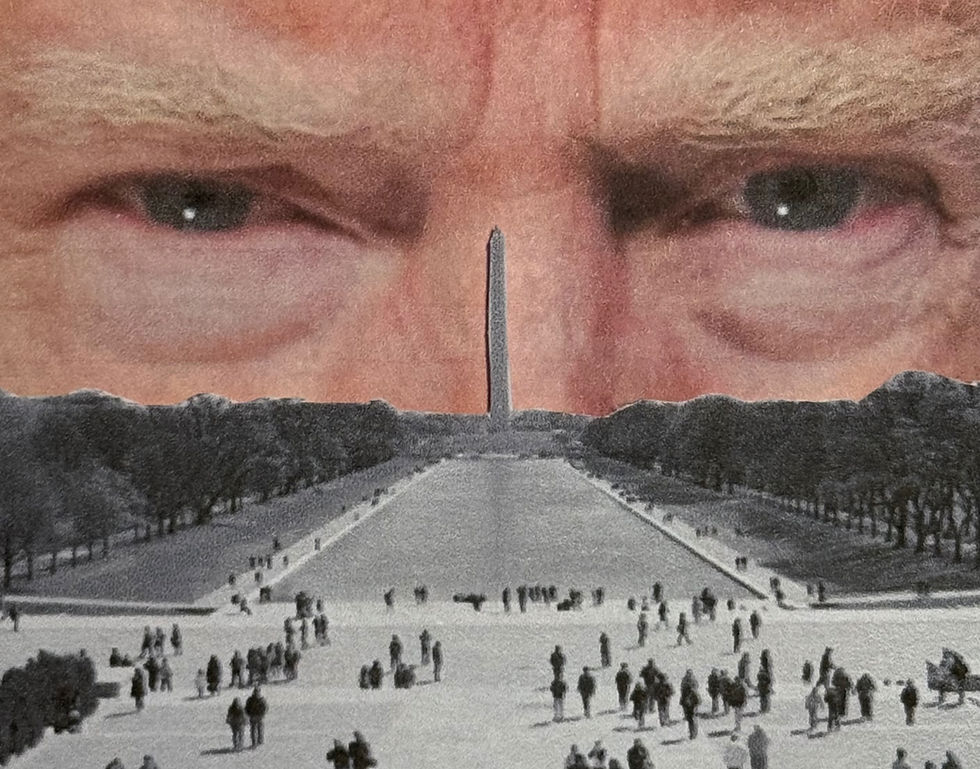
America’s authoritarian tilt is visible just about anywhere you look. You can see it in the institutions Trump has bent to his will, and the way he has pushed his presidential powers well beyond the limits of his office. Yet, I think if you really want to understand the unique authoritarian turn developing in America, you should look no further than Washington DC. Today, the beating heart of America’s federal government is a vision of the country Trump wants to build, and the way he wants to build it - literally. From the White House to Washington’s monuments, its federal agencies, and the people who inhabit them, DC is a perfect representation of the death of America’s democracy.
If you have visited DC, you will know the distinct set of aesthetics that form the heart of America’s federal government. There are neoclassical masterpieces and sprawling brutalist behemoths sat next to one another. There are monuments to past presidents, carefully constructed landscapes, and lasting visions of a time when America and its government dared to do more. As a result, Washington, and its architecture, capture the various visions American democracy has taken on over time - at times expansive and daring, and all too often rigidly rooted in a mythical past. As a result, looking at the city and its landscape tells us a lot about the kind of democracy America is, something which is more true today than ever.
Since reclaiming the White House, Donald Trump has set about remaking this vision of democracy as he sees fit. Many of the neo-classical and brutalist buildings across the city are now adorned with vast banners of the president’s face. Others, like the Kennedy Center and Institute of Peace, have had their facades branded with Trump’s name. The Lincoln memorial has had its reflecting pool drained so its grey granite can be painted ‘American flag blue’, and the White House has had 100ft tall flagpoles erected on its lawns. Each addition seems designed to etch Trump, a man the city has long excluded from its culture, and his specific aesthetic preferences further into the consciousness of the city and its architectural psyche.
These aesthetic undertakings are just the beginning for Trump’s DC. At the White House Trump is constructing a vast 90,000 sq.-ft ballroom, and close to the Lincoln memorial he has drawn up plans for a 250ft tall arch. Neither of these planned additions to the city’s indelible monuments to American democracy are the product of carefully considered designs. The grandiose White House ballroom, with its colonnades, faux windows, and staircases that lead nowhere, is not designed with the forethought of a ballroom for the White House. Neither is the ‘Triumphal’ arch devised for Memorial Circle, designed first and foremost to be a commemorative arch for America’s 250th anniversary.

These pieces of architecture are, like the vast banners and flags unfurled across DC, designed with one thing in mind: to impose themselves on Washington’s landscape. Their size and scale is meant to cut across historic views and avenues that have existed for decades as a signal of the authority of the man who commissioned them, and the way he was able to use it in any way he saw fit. Their supposed grandeur - the iconography, the gold, the columns - is designed to reflect the president’s personal tastes, not America’s. They are monuments that have come into existence purely for the pleasure of the president. They are a reflection of the authoritarian intent within Trump, and the supposed power he commands over his nation.
The scale of these aesthetic oddities is only half of their story however. The authoritarianism of these vast buildings extends well beyond their outward appearances all the way down to the processes through which they have been planned. Like authoritarian architecture everywhere, these giant buildings have had to commandeer the system which oversees the design language of Washington DC and its democratic outputs. At the same time Trump has gutted the federal government and launched wars across the world, he has also taken control of DC doing everything from mandating the style of federal buildings to rapidly expanding the number of federal buildings earmarked for demolition.
To secure total control of the planning system, the president also stacked two critical bodies, the Commission of Fine Arts and the National Capital Planning Commission, with his acolytes - including a 26-year-old personal assistant with no experience in planning or design. With control over the commissions which oversee DC, Trump’s personal aesthetics now take just minutes to approve. In February, the Commission of Fine Arts undertook just twelve minutes of discussion of Trump’s 90,000 sq.-ft White House ballroom before unanimously approving it. A process which contrasted the commission’s previous work, including the nine months of debate and planning required to redesign the fence which surrounds the White House.

However interesting this autocratic architecture is, it is only one part of the story of the aesthetics taking over DC. Alongside the vast buildings and arches, there is another layer to the new aesthetics of America’s capital: its people. The people who inhabit DC and its hollowed out federal institutions tell a similar story about the aesthetic preferences of America’s autocratic president.
Wherever you look, this distinct style is on display throughout DC. It is visible in the White House Press Secretary and her not so subtle botox regime. It is on display at the top of the Pentagon and FDA, where the men Trump selected flex their steroid induced muscles whenever they see fit. It was also visible - until Trump fired both - in the long flowing hair extensions of the head of Homeland Security, and the pink suits and black stilettos of the Attorney General.
The aesthetics on display at the top of America’s federal institutions are interesting because each one has been hand picked by the president. Their selection as the face of this increasingly authoritarian administration signals that the individuals are not just there to do his bidding, they are also in post as an outward expression of what he believes America should look like. The over-the-top botox, muscles, and deeply gendered clothing reflect - like the buildings - a desire for classical maximalism that Trump has total control over. The people are show pieces which reflect Trump’s perceptions of power, and his obsessive desire to control every inch of America and its government, including down to its people.
Just as Rome’s emperors once tore apart Rome to satisfy their egos, Trump is now doing the same to the heart of America and its federal government. The authoritarian architecture and the people which fill it are all expressions of Trump and nothing more. His additions to the city are designed - like those who do his bidding in government - to leave lasting scars on the city’s carefully constructed landscape. The buildings and arches are meant to be too big, just as the strict classical style is designed to impose an uncompromising uniformity. Each design choice taking over DC is a reflection of both the insatiable need American authoritarianism has for control, and its reverence for a mythical past. These ideas extend to the botox and filler, the muscles jacked up by steroids, the thick layers of make up, and endless fake tan, which again signal Trump’s desire to project his personal preferences as far and as hard as he can. The government, along with the buildings in the city, must look like him, and the power he believes he holds.
Illustrations: Will Allen/Europinion


Comments