.png)
Tony Blair's Polemic – The Bitter End to Half a Century of Divorce

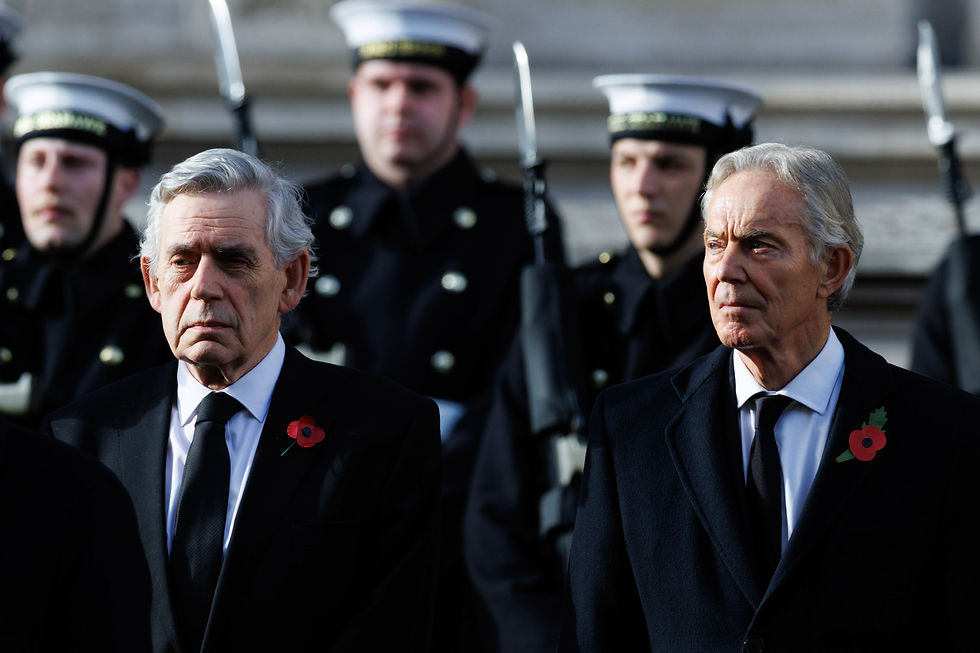
When four ex-cabinet ministers split from the Labour Party in 1981 to form the SDP, they did so with the intention of ‘breaking the mould’ of British politics. This Gang of Four believed the Labour Party was on an irrecoverable journey down the Hard Left flank of British Politics. Veteran left-winger Michael Foot had just been elected leader, the Trotskyite Militant Tendency had successfully infiltrated the party, and Tony Benn was circling, waiting to steal the Deputy Leadership away from Denis Healey. By 1982, the SDP, having quickly formed an alliance with the Liberal Party, were polling at over 50%. By-elections were won in Crosby and Croydon and Glasgow and Bermondsey, 10% of Labour’s parliamentary party had crossed the floor to join them, and at the first Liberal/SDP conference David Steel famously declared ‘go back to your constituencies and prepare for government’, such was the feeling of momentum and confidence.
Yet at the 1983 general election this alliance won just 23 seats, 17 for Liberal candidates and just 6 for the SDP. They were beaten narrowly in terms of votes by Michael Foot’s Labour, despite that party writing the book on how not to run an election campaign in 1983, and their manifesto being dubbed ‘the longest suicide note in history’. The split in the left of centre vote allowed Margaret Thatcher an easy landslide, a landslide she repeated again four years later in 1987. The SDP lost further ground to Labour in 87, now led by left-winger Neil Kinnock, both in terms of votes and seats, and died with a pathetic whimper when in 1988 the party formally merged with the Liberal Party to form the Liberal Democrats, the heady days of 1981 a distant memory.
As Harold Wilson famously said, a week is a long time in politics, and that makes the SDP ancient history. Yet Tony Blair’s intervention into today’s Labour failings does demonstrate how these old wounds still present with painful scars. Kinnock’s leadership of Labour between 1983 and 1992 took the party away from the left and towards a more centrist politics. He was succeeded as leader by the late John Smith who continued this trend and, following Smith’s death in 1994, by Blair who accelerated it into the New Labour project. Many commentators have argued that without the wake-up call that was the SDP, Labour would not have been dragged back towards the center and instead continued its journey down the left and into oblivion.
So where does Blair fit into this? Around the time the SDP broke away the Labour Party was split into two fundamental camps, the Social Democratic right and the Socialist left. These two camps could then be split again, with the right splitting into the New Right (passionate pro-Europeans who believed in trade union reform and much of Thatcher’s market liberalisation policies, many of whom left Labour to join the SDP) and the Old Right (committed to the old norms of the Labour Party such as trade unionism and remained with the Labour Party). The left was also split between the Soft Left (led by Michael Foot) and the Hard Left (led by Tony Benn), who were split over the extent of public ownership in the economy and the need to include big figures from the Social Democratic right in the leadership of the party.
One can see quite clearly therefore that the seeds of Blairism flow through this New Right. Pro-European market liberalisers, these were not Social Democrats at all, but Liberals, thus they were able to agree an alliance with the Liberal Party so quickly. Yet when Blair was elected to Parliament in 1983, it was as a Labour MP, and on a manifesto of leaving the Common Market and mass nationalisation of industry, not as an SDP or Liberal on a manifesto far closer to the policies that would come to be espoused by New Labour in 1997 and in this intervention in 2026.
Why didn’t Blair stand for the SDP? Because when Tony Benn did launch a challenge for the Deputy Leadership of the Labour Party in 1981, he was defeated by leader of the Old Right Dennis Healey (by a margin of 50.4%-49.6%). Had Benn won then no doubt the rest of the New Right and possibly a decent number of Old Right MPs would have flooded into the SDP, now convinced that the Labour Party was beyond redemption. But they didn’t. Benn’s defeat reflected a glimmer of hope that Labour could be saved. And whilst Labour was saved in electoral terms, this underlying tension between Soft Left and New Right was left unresolved. Whilst the Old Right could accept a Foot leadership and drew the red line at a Benn deputy, the New Right figures who had split to form the SDP had considered a Foot leadership beyond the pale.
Many would argue that Blair’s great triumph as Labour leader was to turn the Soft Left into a fundamentally Blairite faction. Figures such as Ed Miliband and Andy Burnham are considered by many to be Soft Left, and both have New Labour blood flowing through their veins. But to call Miliband or Burnham Soft Left is an error. Miliband and Burnham are Brownites, with their politics stemming from the position of Gordon Brown during New Labour, which is better understood as a continuation of the Old Right rather than a reform of the Soft Left. During the New Labour governments, proposals such as electoral reform, joining the Euro and welfare reform were embraced by Blair but vetoed by Brown, a difference that reflects this old divide in the right. Blair’s politics represents that strand of the Labour right that would be fundamentally happier in the SDP, and perhaps therefore belongs in the Liberal Democrats. The real Soft Left of the Labour Party is the politics represented by Angela Rayner, a faction successfully marginalised in parliamentary terms by New Labour, but one that flourishes amongst the membership.
The negative reaction towards Blair’s intervention thereby reflects a party whose elasticity is, and always has been, stretched right to its very limit. The incomplete nature of the SDP’s breakaway in 1981 means Labour remains as broad as it was in that day. For all the theatre of 1981, and all the foundational reform of the New Labour project, Labour still has a New Right (Blairites) which views a Soft Left leadership as beyond the pale. Yet it seems increasingly likely that an Old Right (Brownite) leader, be it Burnham or Miliband, is most likely to take the helm, with both likely to include Angela Rayner, the absolute figurehead of the Soft Left, at the heart of their government.
The power dynamics in the Labour Party are shaking away the New Labour norms of a Blairite-Brownite coalition and returning to the coalition of Old Right-Soft Left, leaving the New Right, as it was in 1981, out in the cold. A New Right that is, and has always been, Liberal in its nature and Liberal in its instincts is a New Right that is not going to stick around for very long. In his interview with the BBC, when the point was made that his latest intervention is seen by most as a set of right of centre policies, Tony Blair responded ‘I’m not tribal’, he’s certainly in the wrong party if that is the case.
Image: Flickr/UK Government (Simon Dawson, No 10 Downing Street)
No image changes made.


Comments