.png)
How Modi's Personality Cult Keeps Outrunning His Government's Troubles
Updated: Aug 17
Less than a year ago, Indian Prime Minister Narendra Modi led every other world leader in the Morning Consult approval rate tracker at 71 percent, 10 points ahead of the second best: Sanae Takaichi of Japan. Back home, a recent news report found that the Indian leader remained the most popular among the country’s youth. The Leader of the Opposition, Rahul Gandhi, trailed him, even in the aftermath of the July unrest triggered by the youth-led Cockroach Janta Party’s (CJP) protests in New Delhi and elsewhere over examination irregularities.
The year 2026 so far has seen two major concerns for Modi’s Bharatiya Janata Party, (BJP), which leads India’s ruling National Democratic Alliance (NDA) in New Delhi: the donation theft scandal at the Ram Temple, arguably the most powerful symbol of India’s flourishing right-wing Hindu nationalism, and the exam-paper leak chaos that sparked a youth outrage as nearly two million young people had to resit their National Eligibility cum Entrance Test (NEET).
Various surveys have suggested that those two incidents have perturbed a significant number of NDA supporters, making the BJP worried ahead of key elections in the coming years. But the saffron party’s biggest assurance remains the man it has relied on for more than a decade now: Narendra Damodardas Modi.
Modi has not brought India the “acche din” or “amrit kaal” (golden years) that his blind supporters often claim. Day-to-day problems that any regime encounters, be it unemployment, inequality, inflation, have got worse. Prime Minister Modi also faces an anti-incumbency challenge that could see him out of a job at the next election. The recent resignation of Dharmendra Pradhan, a powerful minister in Modi’s cabinet who looked after education, in the wake of the student protests, is being seen by many of the prime minister’s critics as the beginning of the end. But realistically, it may seem like a strategic retreat. As the Modi-led government became increasingly accused of targeting protesting youngsters with brutal police action, the prime minister was seen engaging with Gen-Z through late-night Instagram Reels, donning the mantle of a caring elderly person to assure the young generation about a better examination system in place and forgiving some of its members who used abusive words against the PM and even his late mother.
This is where Modi’s political skills lie. Regardless of how his government handles issues, the prime minister has sustained a personality cult, leading to a presidential-type system within India’s parliamentary framework.
Modi is always in a ‘campaign’ mode of governance
Even as he campaigns for the elections, the 75-year-old Modi also controls the narrative through a “campaign” mode of governance. Again, while Modi’s detractors say that he never faces the press because he is undemocratic, can’t defend his rule and goes by scripts, the prime minister never loses contact with the public.
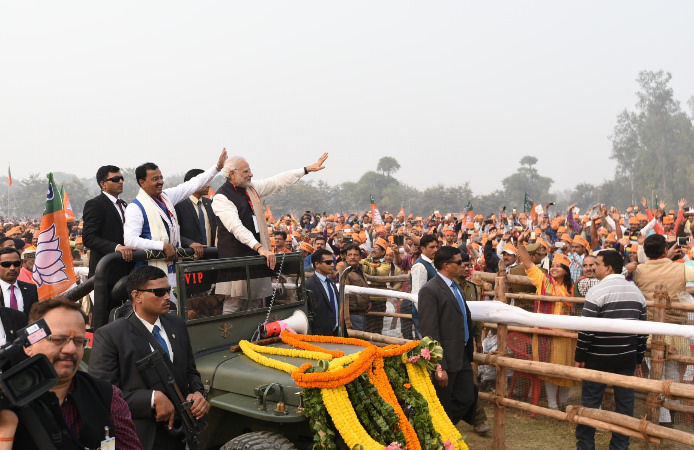
Be it his widely-followed 'Mann Ki Baat' radio broadcasts, active social media presence, the recent Instagram reels or the government's practice of branding welfare schemes with his name or image, citizens are constantly bombarded with the message that Modi is always there, tirelessly trying for their well-being.
Since he led one of India’s relatively developed states more than 12 years before captaining the country, Modi already had a resume that boasted administrative acumen, a fact the media likes to repeat. What stuns Modi’s critics is that despite not having been an insider in Delhi’s power corridors, he transitioned well from Gujarat to the National Capital, replicating his story as a leader in the limelight without an iota of stress. A well-oiled election machinery, steered by an efficient manager, Shah, and backed by a strong cadre, gave the prime minister a robust traction.
Modi’s style of functioning is never ideal for a democratic leader but is successful nevertheless. Critics call him an authoritarian who runs an emergency-like situation in the country, which includes caring little about the free press and the opposition’s thoughts. A favourable media, often mocked as “Godi Media”, makes his task easier. Recent issues, however, such as an exam paper leak, the Ram Temple scandal and the use of ethanol-blended petrol in cars bolster speculations that the Modi era might end in 2029, especially after the BJP’s less satisfying results in 2024.
Modi overcomes hurdles, time and again
But one would draw such a conclusion at one’s peril. In the past, Modi has shown that he has a knack of weathering potentially damaging situations. In Gujarat, he won three consecutive elections despite the 2002 religious pogroms, before becoming the PM. He became the only Indian PM to address the joint session of the US Congress twice despite being denied entry in that country for almost a decade in connection with the 2002 riots. His decision to demonetise major Indian currency notes in 2016 caused suffering and chaos; yet he returned stronger with a bigger victory in 2019, which was completely based on his personal appeal.
Modi, in fact, has a strange capacity to blend the nation’s well-being with a mocktail of economic rise, technological push, nationalist pride and an assertive foreign policy. Although many of these traits have not worked the way his constituency would have liked, Modi’s missions have mostly been appreciated.
Whether or not Modi stays in power till 2029, when he will be over 79, to seek a fourth mandate, things will not be easy either for him or his party. Despite the opposition still lacking a face that matches his appeal, a 15-year-strong anti-incumbency will be tough to deal with, even for a populist leader like Modi.
His party and its ideological camp, including the Rashtriya Swayamsevak Sangh, may choose to ease him out even before the elections, keeping the larger interest in mind. What lies ahead remains uncertain, but there is no denying that Modi has given India political stability and economic aspirations, especially at a time when the global community is far from tranquil.
Image: Wikimedia Commons/ Prime Minister's Office, Government of India
No image changes made.


Comments